Book chapter · 2027
“Huge if true”: Aspirational believing and the appeal of conspiracy theories
- Leibniz Institute of Psychology, Trier, Germany
This chapter has been submitted for publication in Roland Imhoff & Kenzo Nera (Eds.), Handbook on the Psychology behind Conspiracy Theories. De Gruyter. This version may differ from the published one. November 23, 2026
Abstract
Why do people believe in conspiracy theories? I propose that part of the answer lies in what our metacognitive feelings track. Curiosity and the aha experience are fallible markers of truth, but good markers of subjective progress: of gaining grip on a problem through one’s own inquiry. This leads to a different view of belief, which I call aspirational believing. People may accept hypotheses on thinner evidence when acting on them promises control, because that action opens new channels for evidence and agency, whether or not the hypothesis is true. In moderation this sustains exploration, but pushed too far, belief stops reacting to evidence. Conspiracy theories are a prime example of this. They turn diffuse, uncontrollable experiences into plots that can be probed and exposed, and their “do your own research” arcs reliably deliver the felt insights that signal progress. The approach does not require that conspiracy believers experience an unusual need for certainty or control, just that they are optimistically biased in their control expectations (like most of us). I distinguish this account from motivated reasoning, error management and compensatory control accounts, and derive diverging, testable predictions. I close with a tentative remedy: fostering (epistemic and pragmatic) agency may matter more than cleaning up information diets.
Contents
- Abstract
- Feelings of truth: insight and curiosity as fallible guides
- Curiosity and insight in conspiracy belief
- The aha as proxy for progress and control
- Why believing on thin evidence can be rational
- Aspirational believing
- Why conspiracy theories?
- A comparison with existing accounts
- Some unique predictions
- Conclusion
- References
Let’s imagine a retired engineer who starts to notice that some airplane trails linger and spread into peculiar patterns, while others vanish within seconds. Online, someone explains that these are ‘chemtrails’: substances sprayed on purpose, to change the weather or worse. Will he believe it?
Most accounts of conspiracy belief would look for a flaw — a reasoning error, such as seeing patterns or intentions where there are none — or a psychological need that the belief satisfies: for certainty, for safety, or for social belonging (Douglas et al., 2017; van Prooijen, Douglas, et al., 2018). Both treat the belief as something that happens to him. This chapter starts from a different observation. The moment he acts as if the claim is true, things happen that do not depend on whether it is. He orders a rainwater test kit and learns what parts per billion means. He makes photographs of trails and matches them to flight schedules, or he learns how to file an information request with the environmental agency. In short, his actions begin to produce effects he can sense. Notice what he controls now: his samples, his photo archive, or the contacts he makes. But not what is in the planes.
I will argue that this is part of why people believe weird things, conspiracy theories included. Beliefs are adopted not only because they seem true, but because acting on them promises control: new evidence, new levers of control, and a productive loop between action and effect. I call this aspirational believing. Conspiracy beliefs are just one cultural expression of it.
Feelings of truth: insight and curiosity as fallible guides
I start from our metacognitive limits. How do we know when something is truthful? Do we experience veridicality? Our most vivid feeling of truth is what in psychology is known as the feeling of insight or Aha Erlebnis. It’s the sudden, pleasurable realization that we have solved a puzzle and discovered a true regularity in the world (Van de Cruys et al., 2021). Whenever we have this feeling, it comes with great confidence that we are correct (Danek, 2023; Topolinski & Reber, 2010), that what we think now corresponds with reality. Insight requires an initial obstacle: an expectation violation or disfluency that is then overcome through one’s own (mental) effort (Van de Cruys et al., 2024).
Still, we have little insight into how our insights are generated: they appear suddenly, without obvious connections to arguments or our conscious analytical traces of thought. Worse still, experiments show that genuine aha experiences can be elicited for false solutions (Grimmer et al., 2022) and that wrong statements that coincide with aha experiences are seen as more truthful (Laukkonen et al., 2020). In an aha moment, we don’t suddenly get a direct line to the world, untainted by the mental models we see the world through. Like curiosity, our other key metacognitive emotion, aha experiences are markers of definite but situated cognitive operations. They guide our belief formation, but without guarantees on truth.
Metacognitively, an aha experience seems to be caused by finding a solution faster than expected (Dubey et al., 2021). It also seems to be linked to making gains in compressing some perceptual inputs (Schmidhuber, 2009; Van de Cruys et al., 2021), or suddenly reducing previous uncertainty (Doulfoukar et al., 2026). All of these operations are relative to an individual’s perspective, their model of how they construe(d) the world and how fast or well they expect to deal with new incoming information. The aha registers how steeply we descend toward a better model, not whether we have reached the best one (local vs. global minimum). So with the right starting conditions (prior beliefs and the uncertainty they leave) and the right cues (the selected evidence brought to bear), one could manufacture aha moments for false conclusions as easily as for true ones. One could prime someone to ‘discover’ a pre-packaged insight. In fact, that’s what a good teacher does, but so does a manipulator who wants the belief change to feel as if it came from within.
This holds for the metacognitive emotion of curiosity or interest too. People learn better what provoked their curiosity. But curiosity isn’t a taste for the truth. It’s again a local marker of a gap in your models that can be closed, some optimal level of counter-intuitiveness or expectation violation: a manageable (instead of indefinite) uncertainty that can be overcome if we just probe or think it over a little more. It’s dependent on your gaps and your available epistemic actions. As a species so dependent on learning for survival, we are primed for this kind of ‘promise of structure’. And the more we feel our current environment is changing (high volatility), the more we are sensitive to this promise of new learnable patterns, patterns we (might have) missed.
The fallibility of our sense of curiosity or insight doesn’t make them less valuable as markers for navigating our world. They are all we have, in the moment, to gauge our progress in gaining knowledge. Even scientists don’t outgrow these: When they get better results, it is because they have social structures and practices in place to correct them. While everyone can partake in proper systematic truth-seeking, these tools are cultural acquisitions. In this sense, truth is provisioned from without. What individuals have from within are markers of subjective progress.
Curiosity and insight in conspiracy belief
We are all motivated by curiosity-eliciting, aha-affording environments or stories (Mercier et al., 2025), including conspiracy believers (Salvador Casara et al., 2026), who might, by their own self-report, rely even more on their sense of curiosity and insight. We all want our explanations to be somewhat counter-intuitive (Klopfenstein & Mercier, 2026), but conspiracy stories might be especially optimized to be interesting (van Prooijen et al., 2022).
In earlier work (Van de Cruys et al., 2024), my colleagues and I argued that this is no coincidence: conspiracy theories are engineered not for fluency but for discovery. They set up short epistemic arcs, from a challenge or ‘just asking questions’ cue that elicits curiosity, through an epistemic act (often a minimal one, like a web search), to a subjective insight. The aha has several features that seem important to belief formation. It relies on overcoming a disfluency with one’s own actions or cognitive capacities. And we know that what one has generated oneself is remembered better and felt as one’s own (the generation effect; Slamecka & Graf, 1978). The aha also marks closure, so it tends to terminate further inquiry (Thi Nguyen, 2021).
What is clear is that conspiracy believers derive a sense of agency (‘Do your own research’) from completing a self-driven arc from curiosity to subjective insight, same as the rest of us (Carrion, 2018). What drives this is not a demand for first-hand sensory evidence but the need for epistemic agency, which says: “I want to (re)construct knowledge using my own capacities for inquiring, predicting, and explaining, I don’t want to just be fed what to believe.” Such knowledge is gathered in close interaction: either through a physical environment that challenges you, inciting you to actively probe it in new ways, or, more often, through a social interaction and testimony that provides the tension for curiosity or the cues for resolution.
In previous work, we suggested that by enabling epistemic agency, conspiracy theories might work as a proximal promise, a proxy, for broader agency in the face of adversity (Van de Cruys et al., 2024). If conspiracy belief came down to having a surplus of aha experiences and taking each as a sign of truth, it would be a metacognitive error: mistaking the feeling of discovering something for evidence that it is actually there. But the pull of “doing your own research” suggests that it is the doing that people value. So the question becomes what the aha signals, if not truth.
The aha as proxy for progress and control
If our epistemic experiences teach us one thing, it is that we like to overcome obstacles, not just be obstacle-free. We like to act to reveal the world instead of having the world revealed to us. What motivates us is progress through interaction with the world. It is perceiving the effects of our actions on the world. Curiosity, for instance, comes with a desire to resolve it through one’s own efforts rather than simply being told the answer (Metcalfe et al., 2021).
What we can measure from a first-person perspective is not whether our beliefs are true, but to what extent our actions lead to reliable effects, or more formally: the mutual information between actions and future sensor states, also called empowerment (Klyubin et al., 2005). Empowerment is high when an agent’s actions reliably make a difference to what it will sense next, and low when its actions make no difference.
This holds for mental actions as much as for physical action in the world. Empowerment is usually defined for bodily actions and their sensed effects in the environment, but nothing in the definition requires the actions to be physical. Thinking consists of actions too: we redirect attention or try out another framing of a problem. These mental actions have effects as well, only their immediate effects are cognitive rather than physical: a framing that suddenly makes the elements cohere or an association that reduces the space of candidate answers. Such cognitive effects can be registered just like the effects of physical actions, when we realize that the mind is simply the part of the world that happens to be internal (see Kiefer & Hohwy, 2025). One can therefore gain or lose grip in thought, just as one can in the world. Gains in mental empowerment expand what one can think, and with it what one can plan and do.
That is how we can understand aha experiences too. Compression gains, faster-than-expected solutions and sudden uncertainty reduction are all forms of increased grip: after the insight, the problem responds predictably to one’s mental moves. On this view, the aha is a felt indicator of gained epistemic control, of the fact that one’s own (mental) actions have just produced a reliable effect. That may be why it feels like truth and often (though not necessarily) coincides with truth.
The appetite for control appears early in development, focusing on physical manipulation first. In a classic study, Rovee-Collier & Gekoski (1979) tied infants’ ankles to a mobile above their crib. The infants started to kick and laugh more when discovering the contingency. This wasn’t the case for a mobile that moved but didn’t respond contingently (yoked condition). The intrinsic pleasure is linked to the loop of actions that reliably change the sensed state of the external world (empowerment), which we also see in reward-related brain activity for perceived control (Wang & Delgado, 2019). People even press placebo buttons that suggest control but don’t actually make the light turn green faster (Langer, 1975). They are also willing to pay to keep control (Bobadilla-Suarez et al., 2017) and they go where their actions create sensed effects, even when this leaves them worse off. Emergency physicians under high workload pick patients they can finish quickly, which feels productive but hurts overall performance (KC et al., 2020). This is the streetlight effect: people search where their actions have visible effects, not necessarily where the answer is.
Why believing on thin evidence can be rational
Deciding when to let the world change our mind (beliefs) and when to hold on and use our mind to change the world (intentions, desires) seems simple enough at first glance. Beliefs and desires have a fundamentally different direction of fit: world-to-mind vs mind-to-world (Anscombe, 1957). But direction of fit is not given with a mental state; it is learned, through the same fallible loop of acting and sensing. A child who wants to be a “math whiz” may discover from her test results that this is not up to her, and the goal turns into a belief about her (lower) abilities (Van de Cruys et al., 2020). We learn which parts of the world respond to our actions (their controllability) and so can be the object of goals, and which we must simply represent.
The complication here is that some strong beliefs can contribute to making something true. Math confidence can, in part, be self-fulfilling, just like a political candidate’s visible confidence that she will win an election can recruit the supporters to actually make her win (Ngo, 2026). Whether the belief is self-fulfilling is an empirical question, and one learns the answer only by believing and registering the effects. This means a belief can be malleable (weakly anchored by evidence) for two very different reasons: because holding it helps make it true, or because there is little evidence so far. From the inside, this is a hard problem. With an optimistic default, an agent treats its areas of ignorance as areas of agency.
The crux of the problem is that believing sometimes gates the (‘too little’) evidence too. William James (1896) observed that belief on insufficient evidence is often necessary to disclose the very evidence needed to affirm or refute that belief. The possibility of action shifts rationality in interesting ways. By acting, we control perception. It simultaneously sets you up for unique evidence (sampling that wasn’t available without prior beliefs) and for a confirmation bias (sampling to support prior beliefs).
The two cannot be fully pulled apart. Searching requires a hypothesis that tells you where to look: there is no sampling from nowhere, as Popper’s “searchlight” theory of observation already held (Popper, 1979). And sampling where a hypothesis predicts a positive result is not a defect as such: Klayman & Ha (1987) showed that such positive testing is often the more informative strategy (failing only in particular task structures such as Wason’s selection task). The prior doesn’t just color the data, it selects which data get to exist for you. The dark side of this shows in the study by Chandra et al. (2026) on sycophancy in chatbot interactions, showing that delusional spiraling can happen even in an ideal Bayesian reasoner, driven by the bot’s selective sampling of true facts. Correct updating is no protection when the sampling is selected.
So the reason belief on insufficient evidence can be rational is that it unlocks new data and opportunities for control. It is in this context that the so-called “causal illusion” (Blanco, 2017), our tendency to overestimate the link between actions and outcomes, should be seen. The system prefers Type-I errors (seeing non-existent causation) because they sustain exploration and testing, which discloses the data we need so much to expand our models. Meanwhile, Type-II errors (missing real causation) lead to the passivity of learned helplessness. For example, Blanco, Barberia & Matute (2015) report that paranormal believers respond more often in contingency tasks, expose themselves to biased samples, and develop stronger causal illusions.
The causal illusion is part of a family of optimistic biases, such as overestimation of one’s abilities and overprecision of one’s beliefs (Hoffrage, 2004). These biases are strongest in high-controllability domains where behavior can indeed influence outcomes (Klein & Helweg-Larsen, 2002). They are not a failure of metacognition, but a largely internally rational tendency to believe what gives control and sustains engagement, which provides feedback from the world.
Believing one’s actions have expected effects, and more generally believing there are causes behind some observed effects, creates opportunities for testing and intervention. Discovering regularity (hidden causes) is control, and the expectation for regularity is expectation for future control. A natural extension is the agentic bias, seeing (evil) actions by agents behind everyday (adverse) events. Again, the pragmatic rationality is in what this belief would disclose in terms of unique evidence and control.
Aspirational believing
I call this lowered acceptance criterion (c) for hypotheses whose acceptance raises expected control, while evidence weighing (d′, likelihoods or precision) stays intact, aspirational believing. Expected control is here understood as expected empowerment gains. Crucially, this is computed under the agent’s own model, so it can be overestimated.
Again, William James (1896) provides a useful framing. Believing, for him, is a trade-off between two motives: “Believe truth!” and “Shun error!”. “Believe truth” focuses on actively gathering and gaining real knowledge, even if it means risking being wrong multiple times. “Shun error!” emphasizes avoiding falsehoods and staying skeptical, even if it means missing out on discovering the truth. As Rachel Fraser (2022) argued, conspiracy belief could be seen as epistemic FOMO: fear of missing out on true beliefs at the expense of committing to false beliefs. Or, to stay away from a fear-defined description, we could call it the “huge if true” attitude (Altay et al., 2022). The implications for action (control) are just too big not to believe it a little. Box 1 works out an example.
The resulting shifted criterion is not a purely strategic response bias, in the sense of posing as if one believes something for practical benefits. It’s about actually adopting beliefs, because believing licenses actions, and actions generate new evidence. Acting as if a hypothesis is true changes what you sample, so a threshold shift at time t becomes a credence shift at t+1. Aspirational believing is a criterion shift that becomes a belief through the sampling it licenses.
Where could such a lowered criterion come from (lower than the evidence alone would require, i.e., Δ = 0 in Box 1)? Aha may be a learning signal that sets the accepting criterion: people whose “own research” yields frequent aha experiences may learn a lower threshold. If the aha is a felt marker of gained control and a basis of expected control, frequent ahas teach the agent that acting on tentative hypotheses pays off. This makes the criterion a learned setting, which can differ between domains and change with experience, rather than a fixed trait.
Aspirational believing fails when the only checks on a hypothesis come from inside the loop it organizes. Consider the engineer again. His samples and his contacts respond to what he does. This is real control, but it is control over his investigation, not evidence for the plot. Aspirational believing lends the control experienced in acting to the hypothesis that organizes it, on the more abstract level. Each small aha along the way (a matching flight schedule, a high reading) confirms a subhypothesis and passes its credit up to its parent, conferring confidence and expected control to H. This is harmless as long as the world can still push back on H through channels the loop does not produce. When it cannot, the result is a prior that gets locked-in, not because evidence is ignored, but because all the evidence comes from where H indicates to look (because that’s where it was ‘productive’ to look).
There are hints of a shifted criterion in existing data. Conspiracy believers tend to stop sampling earlier in the beads task, and so ‘jump to conclusions’ (Pytlik et al., 2020). As Moritz & Woodward (2004) proposed, this might be an expression of liberal accepting: believing on thin evidence, instead of avoiding lack of evidence (uncertainty) or a deficient evaluation of evidence. When measured more directly, as plausibility ratings for interpretations of ambiguous scenarios, liberal accepting was indeed found to be associated with (in this case coronavirus-related) conspiracy belief (Kuhn et al., 2022). Similarly, Fock, Winter, Pummerer & Imhoff (2025) found that conspiracy mentality predicted a response bias, not a difference in discrimination: a general tilt towards rating real conspiracy theories as credible regardless of their actual plausibility (see also, Tagand et al., 2026). Müller & Hartmann (2023) found that conspiracy beliefs were linked to a more liberal response bias, depending on the base rate. While these studies are consistent with a Jamesian signature (a shifted willingness to say “yes, believe it”), they did not systematically vary payoff structure, but plausibility or base rate instead (see predictions section).
There are more signs of optimistic expectations of control in the literature on conspiracy beliefs. Salvi et al. (2025) found conspiracy believers tended to overestimate the solvability of compound remote associates puzzles that were actually unsolvable, based on a 5-second preview of the puzzles before actually trying to solve them. This could be just another expectation there’s a signal there, the willingness to bet that there’s regularity (and possibility for control) on less evidence. Other findings concern optimism about one’s own mastery and control, rather than about hypotheses. Across eight studies, Pennycook et al. (2026) found conspiracy believers to overestimate their performance on numeracy and perception tests, even after accounting for actual performance, and conspiracy belief correlates with a sense of uniqueness (Imhoff & Lamberty, 2017). These optimistic biases are not the same as liberal accepting, but the two should go together in the current account. Overestimating one’s abilities to know and to act is overestimating one’s own empowerment. That inflates the bonus for hypotheses that give one something to do (Box 1), and so lowers the bar for accepting them.
Box 1. A worked example
Consider a case where the truth is genuinely open. Suppose you hear that the factory upstream has been secretly dumping chemicals in the stream behind your house. You have seen a dead fish and heard a rumor. Should you act as if the rumor is true: take water samples, warn the neighbors, and bring it to the council? The textbook approach weighs two things: One is what you gain if you act and the rumor is true. For example, you catch the polluter and protect your children. The other is what you lose if you act and it is false. For example, lost weekends and embarrassment, or an angry factory owner.
If being right pays more than being wrong costs, you should act before you are even 50% sure. This is the logic of the smoke detector and of error management theory (Haselton & Nettle, 2006). The bigger the payoff of being right relative to the cost of being wrong, the lower the bar.
This still misses something. The gains and losses depend on whether the factory is guilty. But the moment you start acting as if it is, things happen that do not depend on its guilt. You buy a test kit and learn what nitrates are. You meet neighbors you did not know yet and you find out how the council agenda gets set. These factors are now in your control (not the factory’s guilt). Now consider the rival explanation: the pollution stems from a liberal use of pesticides in fifty different farms upstream, and nobody in particular is to blame. It may well be the likelier story. But it gives you nothing to do. One hypothesis gives you levers of control; the other one does not. Let’s call this difference the empowerment bonus. It is the gain in control a hypothesis opens up when you act on it, whether or not it is true. Note that what counts is the control you expect, which need not be the control you will get.
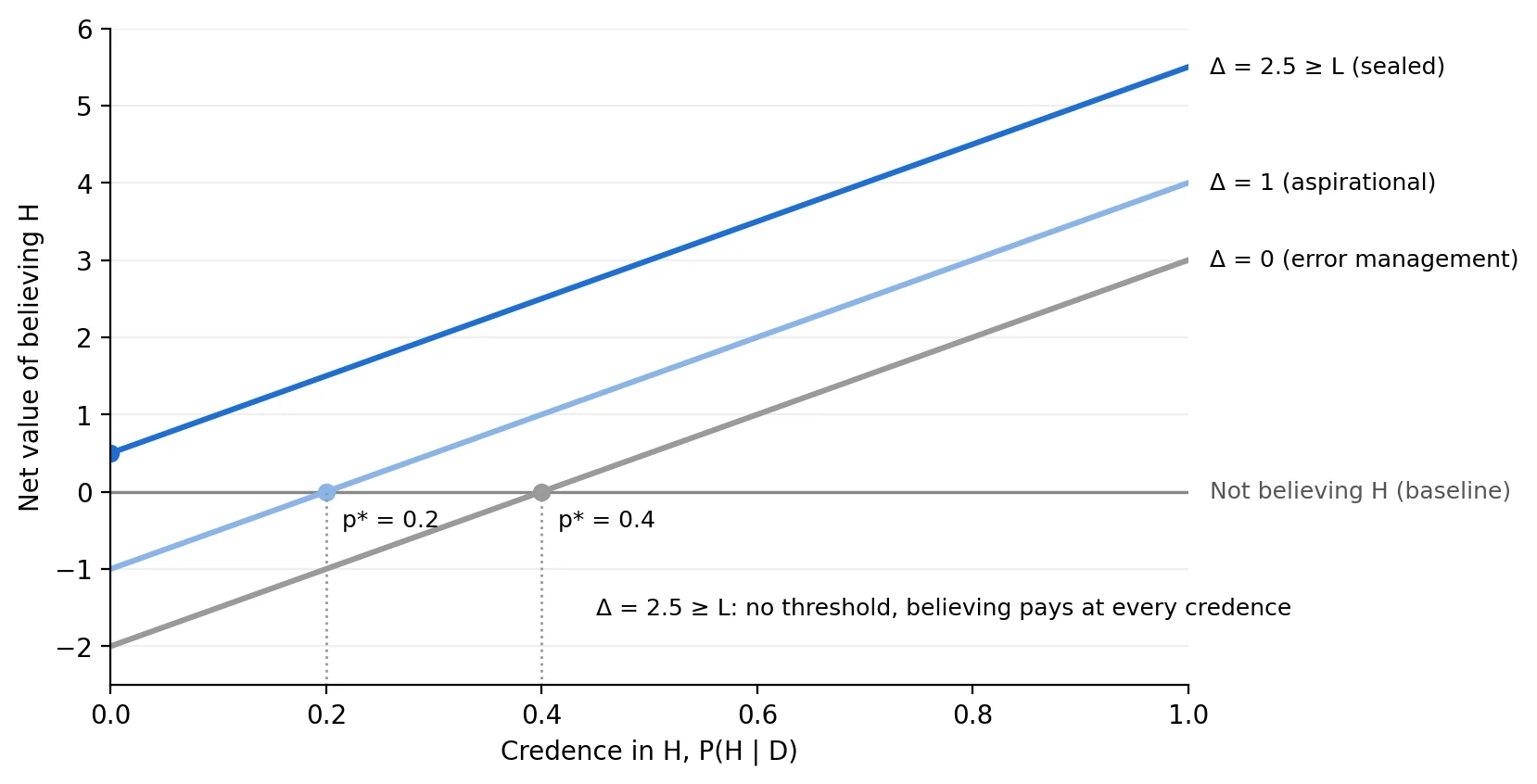
Adding this bonus to the calculation changes the decision qualitatively (Fig. 1). While the unequal costs of errors change the slope of the decision line, the empowerment bonus lifts the whole line. A modest lift lets you believe on thinner evidence, which is what anyone chasing a hunch needs, scientists or start-up founders included. But the lift has no natural ceiling. Once the bonus is as large as the cost of being wrong, the line never drops below zero. Acting as if the factory is guilty now wins even when you are all but sure it isn’t, and evidence makes no difference anymore. Here aspirational believing becomes sealed believing. That transition is not about people who reason worse, but about situations where the rival explanation offers no levers at all, so the bonus is large, or where people have little left to lose in mainstream channels, so the cost of being wrong is small. (For a real-world case where suspicious, stubborn outsiders did produce tests and were vindicated, see the Flint water crisis.)
A formal decision rule. Believe hypothesis H, that is, treat it as true in reasoning and action, when p·G − (1 − p)·L + Δ > 0, where p = P(H | D) is your credence in H given the evidence D; G is the gain from believing H when it is true; L is the loss from believing it when it is false; and Δ = λ · [Ê(believe H) − Ê(believe ¬H)] is the empowerment bonus. Ê is the agent’s own estimate of its empowerment: the most information its actions (A) can carry about its future sensations (S’), E = max I(A; S’). λ weighs control against the other payoffs. Setting the left-hand side to zero and solving for p gives the threshold for believing: p* = (L − Δ) / (G + L). Error management theory (see next section) is the special case Δ = 0. When Δ ≥ L, the threshold is p* ≤ 0, so acceptance no longer depends on evidence.
Why conspiracy theories?
The idea of believing for control seems at odds with the fact that believing in conspiracy theories does not provide any actual control. In humans, so dependent on learning, control has to be conceived in its broader sense, to include epistemic control: It is about believing to disclose new evidence (of a possible conspiracy), about organizing socially to build the channels to disclose that new evidence, and about discovering underlying regularities as proxy for future control. Epistemic agency is a precondition to actual agency (Van de Cruys et al., 2024), which is why I started from personal epistemic experiences and the continuity of physical and mental actions.
Here, direction of fit matters again. Conspiracy beliefs are mostly not of the self-fulfilling kind (no pragmatic control) but of the evidence-disclosing kind (epistemic control): believing changes which evidence you get, not what is true. The difficulty is that one only learns which kind a belief is by acting on it and watching, and that evidence is confounded. When X happens, ‘my belief helped’ and ‘it would have happened anyway’ are hard to tell apart (source of the illusion of control). Overestimating controllability lets hope move credences in things one cannot affect (magical thinking, ‘manifesting’). Underestimating it freezes beliefs one could in fact move (helplessness, modeled as a learned prior over controllability; Huys & Dayan, 2009). Conspiracy communities blur the line further. Claims like “enough of us waking up will change things” are partly self-fulfilling at the collective level, and that genuine controllability can leak into the factual claims (“they are hiding X”) the movement organizes around. If there was a conspiracy, the only way to know/verify is through community, which is what conspiracy believers are mobilizing. The felt control over one’s own social ‘problem-solving’ is easily credited to the (higher-level) hypothesis that organizes it. Conspiracy beliefs that are inert for action may be sustained by the curiosity-and-aha loops.
Of course, we also have to see this against the background of a history of adversity and exclusion, perceived or real, practical or epistemic (Hornsey et al., 2022; Imhoff, 2015; van Prooijen, Staman, et al., 2018). Current mainstream views are perceived not to work, or as giving no control at all. Beliefs that provide action policies are preferred over accurate but inert models of the world. Even if they leave people worse off (e.g., more anxious; Liekefett et al., 2023). Conspiracy theories convert an uncontrollable problem (a virus, diffuse market forces) into a controllable one: a plot that can be exposed or resisted. Doomsday prepping does something similar, replacing a diffuse, uncontrollable catastrophe with a concrete project with checklists, stockpiles and visible progress (Mills, 2019). In line with this (but outside the conspiracy domain), Campbell & Kay (2014) showed that belief in a problem depends on how palatable its implied solution is. This is belief that follows action affordances.
Now consider another widespread but culturally-accepted (even encouraged) ‘optimistic control’ belief: meritocratic determinism. It is almost the mirror image of conspiracy beliefs, even though its core is practically identical. Meritocracy says outcomes are directly driven by internal effort, personal capacities and virtues. Conspiracy theories say outcomes are directly driven by external malice. Both preserve the self and reinforce action policies. In a perverse sense, conspiracy theories can be seen as a way to save meritocratic determinism in the face of adversity or failure. If only we can remove the interference by a hidden, all-powerful (all-controlling) actor, we can take control of our own destiny again. The idea that human intent (control) determines outcomes is never punctured. We never have to face the uncontrollable randomness of life. Both prefer agentic, intentional explanations (“someone did this”) over non-agentic ones (“this emerged from decentralized incentives and feedback loops”). Agentic cues (naming a plotter) may themselves signal high expected control, since problems caused by agents could historically be addressed by exposing, punishing or negotiating with those agents.
A comparison with existing accounts
Control and asymmetric error costs are long-standing themes in research on conspiracy belief, so the differences need to be spelled out clearly (for a meta-analytic synthesis of the motives associated with conspiracy belief, see Biddlestone et al., 2025; Hornsey et al., 2022).
Aspirational believing is not wishful believing in the sense of adopting beliefs which cast the world in more favorable lights (which wouldn’t fit conspiracy beliefs anyway, see Liekefett et al., 2023). Motivated reasoning involves biased weighing of evidence, while aspirational believing, in its minimal form, only shifts the threshold. It selects which hypotheses one entertains, acts on and samples for by how much control acting on them promises, while the weighing of evidence can stay intact, at least at first.
The contrast with error management theory and related signal detection accounts of conspiracy beliefs (Aubert-Teillaud & Vaidis, 2024; Haselton & Nettle, 2006; van Prooijen & van Vugt, 2018; see also the chapters on error management and on socio-structural signal detection in this volume) should also be put clearly, even if the type I vs type II error logic is shared. In those proposals, the criterion is set by the costs of errors, usually threats such as coalitional conflict or being cheated, and the justification is ultimate: In ancestral environments, our minds evolved to err on the safe side (Haselton & Nettle, 2006). In the approach here, the justification is proximal and information-theoretic. The criterion is set by expected empowerment, that is, by how much the coupling between one’s actions and one’s future sensations would grow if one acted on a hypothesis, estimated in part through the metacognitive signals discussed above. No ancestral payoff matrix is needed, which makes the account domain-general, not limited to threatening or agentic hypotheses.
The compensatory control theory (Kay et al., 2008; Landau et al., 2015) also focuses on control, but says something substantially different. In compensatory control theory, beliefs compensate for lost personal control by affirming that someone else is in control: God, the government, or even one’s enemies. Aspirational believing values beliefs that provide me control. The compensatory account says that low control leads people to seek external order, while this one is extrapolative: an optimism prior on control leads people to accept hypotheses that promise it. Some experimental evidence already finds no increased conspiracy beliefs after manipulations that lower perceived control, contradicting the compensatory control account (Stojanov & Halberstadt, 2020).
Many needs-based accounts share another assumption: that conspiracy belief addresses an aversive state, such as an excessive need for certainty or control, or anxiety about not knowing (Biddlestone et al., 2025; Douglas et al., 2017). Establishing an ‘excessive’ need would require experiments that carefully manipulate, quantify and equate experienced uncertainty and control. The standard behavioral markers of uncertainty intolerance, such as Ellsberg’s (1961) urn task that probes ambiguity aversion, have not yet been tested in conspiracy believers. Interestingly, a classic study by Heath & Tversky (1991) shows that ambiguity aversion reverses into ambiguity-seeking whenever people feel competent in a domain, even sacrificing expected value to bet on their own vague judgments over matched chance lotteries. It suggests that ambiguity preferences track expected empowerment (epistemic control) rather than mere uncertainty avoidance.
The anthropologist Malinowski’s observation that the Trobriand Islanders had magic for deep-sea fishing but not for lagoon fishing illustrates the difference (Malinowski, 1948/2013). The Trobrianders were skilled boat-builders and navigators, so it’s not that they forgot practical rationality. Malinowski argued they used magic specifically to reduce anxiety in the face of the increased uncertainty and lack of control linked with deep-sea fishing. An aspirational believing view has a different emphasis: the Trobrianders have an optimistic bias to see uncertainty that is yet to be mastered as uncertainty that can be mastered: an area of ignorance is taken as an area of agency. Even if the rituals cannot enforce their ultimate goals, by being sensorimotor patterns, they establish that one’s actions have effects, which boosts the agency required to take on the uncertain quest. In animals too, uncertain or withdrawn rewards elicit more vigorous and more variable responding — as if there is more control to be had — (Anselme et al., 2013), and many animals prefer to work for food — food under their control — instead of getting it for free (contrafreeloading; Inglis et al., 1997).
Finally, aspirational believing may hold a deeper change in how to think about belief formation and rationality than it may appear. Superficially, aspirational believing may seem to be just another needs-based account: a peculiar elaboration of the ‘control motive’. Needs-based accounts conceive of motives as something added to an otherwise truth-seeking system. The set-up in Box 1 seems to reinforce this view: It keeps credence and the empowerment bonus apart. But that framing just makes the comparison with signal detection accounts easy. On a maximalist reading, the present account has just one imperative: toward actions that make a reliable difference to what one senses next. Evidence matters because a model that misdescribes the world will sooner or later mispredict what one’s actions do. Truth-tracking is then just what empowerment-seeking looks like when the loop includes channels that the agent does not control: The world that pushes back persistently. Where those channels are sparse, the same motive leads to aspirational believing. This puts the nontrivial problem of learning the direction of fit of mental states —learning which channels to keep open— central.
Some unique predictions
Control, not desirability, moves the criterion. Because prior odds and payoffs shift the criterion in a similar way, a liberal criterion could simply reflect wanting a hypothesis to be true. A neutral task can separate the two. On each trial, participants see a few draws and judge whether they come from urn A or urn B, with fixed, symmetric rewards for correct answers. Two factors vary across blocks. Desirability: a bonus is paid whenever the urn is A, whatever the participant answers. Actionability: answering “A” unlocks a short follow-up in which participants either choose further draws themselves or watch the same draws chosen by another participant (yoked). This follow-up does not affect pay. Desire-based accounts predict that the bonus lowers the criterion (c) for “A”. Aspirational believing predicts that the self-chosen follow-up does, with sensitivity (d′) unchanged. The same design can test a stronger version: if empowerment also drives the weighing of evidence, an (unpaid) confidence rating after the follow-up should shift more after self-chosen draws than after the identical yoked ones (see Chambon et al., 2020).
Conspiracy explanations promise more control. When people rate expected empowerment (“if this were true, how much could you find out or do?”) for conspiracy and mainstream explanations of the same event (matched for plausibility in a pretest) the conspiracy versions should score higher, and that rating should mediate endorsement over and above perceived threat and desirability. Giving the mainstream explanation an (epistemic or pragmatic) action route of its own should reduce the gap.
Compensatory control vs. aspirational believing. One could present the same conspiracy story with or without a personal route to action, such as a way to help expose it. While compensatory control predicts no difference, since the external order is supplied either way, aspirational believing predicts higher endorsement when there is an action route.
Insight can set the threshold. Frequent aha experiences during self-directed research should lower acceptance thresholds. Insight should also (briefly) raise the sense of agency and control (see Yu et al., 2024).
Conspiracy theories can rescue meritocracy. After priming meritocratic versus luck framings and an unexplained loss in a rigged game, meritocratic priming should increase attributions to deliberate rigging. Offering a personal action option (even if just to learn more) should reduce those ‘malicious’ attributions. Personal failure (downward mobility, unmet expectations) should predict conspiracy belief more strongly among people high in meritocratic belief than among those who already make structural attributions.
Conclusion
We are optimistic if we, with the best intentions, say to conspiracy believers: “be open, receptive, critical!”, thinking that this is all we needed to “see the facts” and “not fall for conspiracy theories”. The lecture to “keep your priors open” treats openness as a dial under voluntary control, but openness is a belief as well: A learned estimate of how much each source deserves trust, shaped by a history of what updating on it has been worth. Everyone’s trust in sources is skewed, a good scientist’s more than most. The question is how the “openness” of different channels —set by their direction of fit— gets calibrated. One cannot decide to be open any more than a person with a strong hopelessness prior can just decide the hopelessness is miscalibrated. Nor is liberal accepting itself the problem. Conspiracy believers may show it more strongly, but aspirational believing is not specific to them. It extends a tendency we all share and need (“I should know impactful things”), not an aversion peculiar to them (“I just can’t stand not knowing”).
What is clear is that curiosity, if we are able to sustain it across a diversity of channels, is protective. We are most receptive to learning new things when the question comes from within and we feel it is within reach. But even intrinsically-driven curiosity is not our own achievement. It is provisioned from without, by parental support, cultural scaffolding, social safety and security. We, for each other, provide occasion to turn uncertainty into curiosity. Scaffolding does not mean I’m resolving uncertainty for you, it means I epistemically and resource-wise make challenges surmountable with your own agency. The question then becomes who gets to inhabit a world stable enough to hold beliefs loosely. The Jamesian “Shun error!” is often a luxury product. Remaining in contact with reality is indeed a precarious social achievement (Williams et al., 2026).
So epistemic environments may not just be due for a clean-up, as misinformation fighters hold. The whole substructure of society needs to empower and offer opportunities for (epistemic and practical) agency. That challenge could deepen as artificial intelligence pervades our daily life, which may well disempower us in new ways (Kulveit et al., 2025).
However embarrassing we feel conspiracy beliefs are, they are a form of alternative world-building, an effort to make sense of and therefore remake the world around them, to get a productive action-effects loop going, however stunted. Out into the hopeful future, not for free comfort but for the joy and necessity of overcoming.
Acknowledgments
I’m supported by an Alexander von Humboldt fellowship. I want to thank Jo Bervoets for enduring, thoughtful discussions of these ideas, and Kai Sassenberg, Kenzo Nera, and Roland Imhoff for helpful feedback on earlier versions of this chapter. Any oversights or errors remain my own.
AI use statement
I used Claude (Anthropic) for literature search, conceptual discussions, the construction of the SDT example in Box 1, and copy-editing for readability. All theoretical claims, syntheses, and final phrasings are my own.